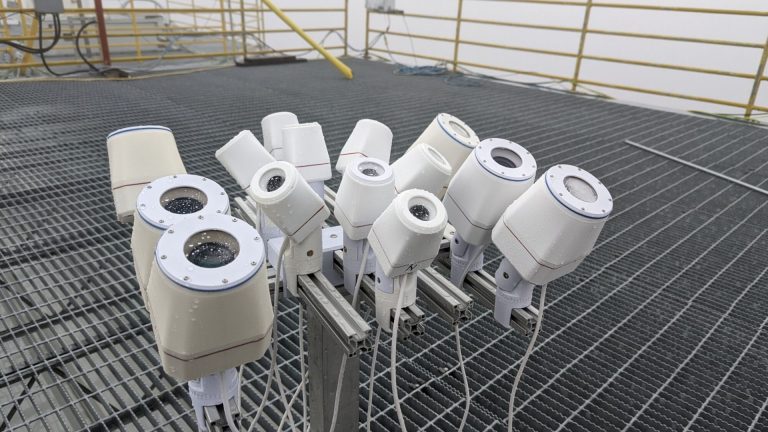


With a goal to enhance the safety and security of Canada’s space systems, a team at Western University has developed a unique network of low-cost satellite-tracking cameras that can detect meteors and monitor satellites across the country.
The system, devised in collaboration with Defence Research and Development Canada, is delivering Canada’s first continuous satellite monitoring and is capable of detecting any Canadian or foreign object over the country larger than 30 centimeters. By tracking brightness, the cameras pinpoint each satellite’s exact location in the sky and determine whether it is stable or tumbling out of control, providing critical information for preventing unintended collisions in space.
Each camera has exceptional sensitivity and uses rapid imaging to scan the entire sky and capture dozens of images per second, allowing it to track satellite constellations, rocket bodies, and other debris in low Earth orbit, all while continuing to monitor meteors. One station located in Eureka, Nvt., in the Canadian High Arctic has now provided a full winter season of data with more than tens of millions of individual satellite observations over the North Pole.
At a fraction of the cost of traditional systems, the network provides sovereign coverage of Canada’s North, advances understanding of the space environment, and strengthens the nation’s ability to persistently monitor wide swaths of space overhead.
For more information, visit Western University