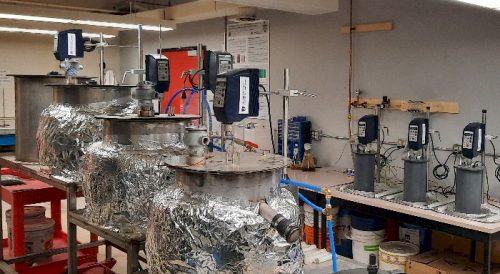
A new approach to research is emerging to better meet today’s global challenges – one that rethinks how scientific discovery happens. Through the Acceleration Consortium at the University of Toronto, researchers are building advanced laboratories that use AI and automation to dramatically speed up discovery and innovation. The goal is simple but transformative: to find solutions to complex problems faster, from clean energy to health care.
Traditionally, scientific breakthroughs can take years, or even decades, to move from idea to having real-world impact. The Acceleration Consortium is changing that by combining AI, robotics and advanced computing. These next-generation, self-driving labs can run continuous experiments, analyze results in real time and rapidly refine their approach. Discoveries that once took years can now happen in a fraction of the time and cost, opening the door to faster innovation and real-world solutions.
Across the consortium, teams are collaborating to advance research that has the potential to improve the lives of Ontarians in tangible ways, with innovations such as:
- Health care and medicine
- Identifying promising drug candidates more quickly and helping to accelerate the development of life-saving treatments
- Exploring new materials for more durable and longer-lasting medical devices
- AI-powered laboratories
- Building “self-driving” labs that can run thousands of research experiments with minimal human intervention
- Empowering researchers to focus on big-picture challenges while AI technology handles repetitive tasks
- Clean energy and sustainability
- Discovering materials for longer-lasting batteries and more efficient renewable energy systems
- Designing low-carbon and environmentally friendly alternatives for industrial processes
- Advanced materials and manufacturing
- Creating stronger, lighter and more adaptable materials for use across industries
- Reducing development time to bring new materials from the lab to the market
Beyond the lab, the consortium is growing their partnerships, investments and opportunities for students by bringing together experts from academia, industry and government to scale innovation and strengthen Ontario’s role in the global knowledge economy. Students are also gaining hands-on experience with emerging technologies to prepare them to lead in science.
By transforming how discoveries are made, the Acceleration Consortium is helping to find solutions that can improve lives, strengthen communities and drive sustainable growth. It’s a powerful example of how universities are advancing knowledge, solidifying Ontario’s position as an innovative hub to support Canada’s scientific landscape, and actively shaping a better future.
For more information, visit the University of Toronto.
Published on April 13, 2026.